 how-to
Why Does Site Waste Removal Keep Failing?
Last Updated: November 10, 2026
Quick Summary
Site waste removal fails because of small, repeated gaps in planning, ownership and follow-through rather than one bad decision. Bins get ordered late, nobody owns the segregation rules, and collections are booked only when a bin is already full. The problems repeat because nobody measures them, so fixing the measurement makes the rest easier.
- Bins should be booked before they hit 75% full to prevent overflows.
- Run a five-point bin audit weekly to catch segregation failures early.
- A one-page plan pinned in the site shed beats a 30-page document.
- Keep transfer documents, weighbridge tickets and facility licence numbers for each load.
- Track contamination rate, missed collections, diversion rate and cost per tonne as KPIs.
Table of Contents
- Why Site Waste Removal Fails: The Problems That Keep Repeating
- Common Construction Waste Management Problems and How They Start
- Construction Waste Segregation: Where Mixed Waste and Contamination Begin
- Building a Construction Waste Management Plan That Assigns Ownership
- Getting the Construction Waste Collection Schedule Right
- Lawful Disposal, Waste Transport and the Evidence Your Site Should Keep
- Measuring What Matters: KPIs and a Practical Site Diagnosis
- Book a Waste Removal Run That Turns Up When It Says It Will
- Frequently Asked Questions
Why Site Waste Removal Fails: The Problems That Keep Repeating
Most site waste removal failures are not caused by one bad decision. They build up from small, repeated gaps in planning, ownership and follow-through. This guide looks at why those failures keep happening, and what site managers can do to stop the cycle.
A common pattern on construction sites is this: bins get ordered late, nobody owns the segregation rules, and the collection truck turns up when the site is locked up. None of these are dramatic problems on their own. Together, they cost time, money and compliance risk.
Below, we'll show you exactly how to diagnose the failures on your own site, assign clear responsibility, and set up collection systems that actually work. The problems repeat because nobody measures them. Fix the measurement, and the rest gets easier.
Common Construction Waste Management Problems and How They Start
Construction waste management problems rarely appear overnight. They start quietly, usually in the first week of a project, and get worse with each trade that comes on site.
Here are the most common ones we see:
- No plan before mobilisation. Bins arrive after waste has already piled up.
- Mixed waste by default. Everyone throws everything into one bin because it is faster.
- Unclear ownership. Site manager, foreman, subcontractors: nobody knows who books the skip.
- Late bookings. Collections get ordered the day the bin is full, not before.
- No site induction on waste. New workers copy whatever the last person did.
For a broader look at how these problems play out across industrial and construction sites, see our practical guide to waste removal for industrial sites.
Construction Waste Segregation: Where Mixed Waste and Contamination Begin
Construction waste segregation fails at the point of disposal, not at the bin. Workers sort correctly only when the bin is close, clearly labelled and easy to use. Put a mixed-waste bin 40 metres away from where the offcuts are, and everything goes in together.
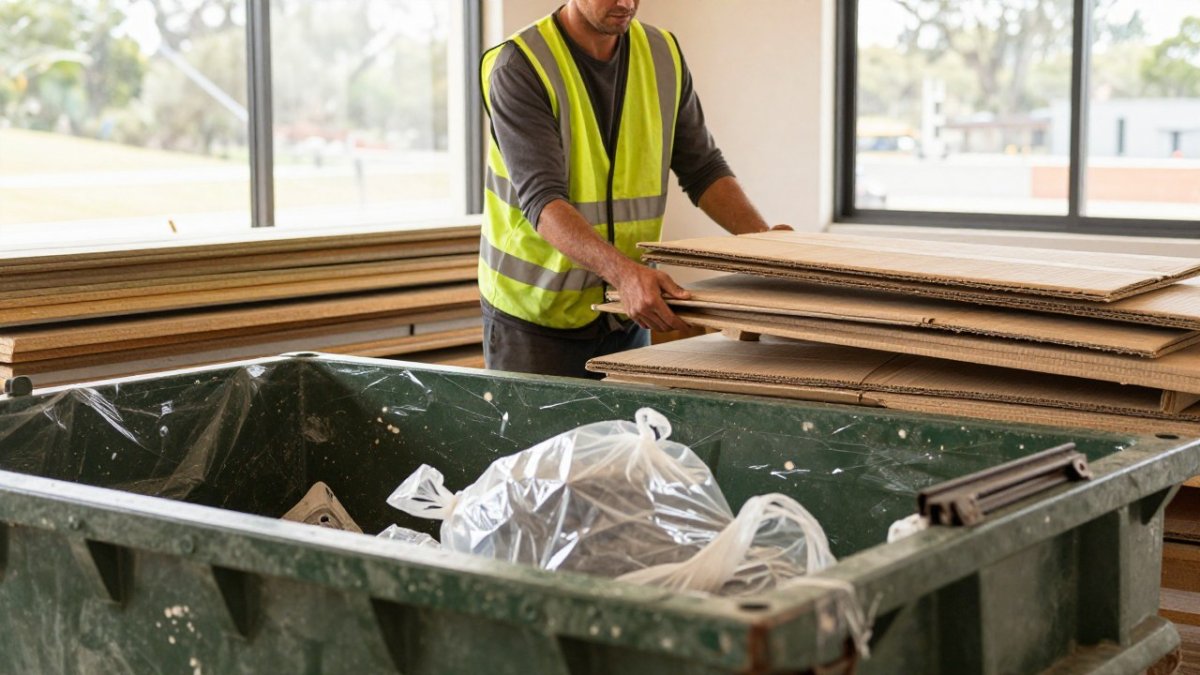
Contamination usually starts with three things:
- Wrong bin placement. Bins too far from the work area.
- No visual cues. No signage, no colour coding, no labels.
- Rushed trades. Clean-up happens at the end of the day, in a hurry.
Once a skip is contaminated, the whole load can be downgraded to mixed waste. That means higher disposal costs and less material recovery. Source separation only works if it is easier than the alternative.
A practical way to diagnose segregation failure on your own site is to run a five-point bin audit each week. Check bin distance from active work faces, signage legibility, colour coding consistency, visible contamination in each bin, and whether the last collection record matches the bin's stated contents.
Measure contamination rate as the percentage of bins rejected or downgraded at collection. Track it weekly and compare it against your diversion rate, the share of waste reused or recycled rather than sent to landfill. If contamination rises while diversion falls, the problem is usually bin placement or signage, not worker attitude. If both stay flat but cost per tonne climbs, the issue is likely collection frequency or bin sizing.
Watch out: a single contaminated skip can downgrade an entire load, so spot-check bins the day before collection rather than after the truck has already turned up.
Building a Construction Waste Management Plan That Assigns Ownership
A construction waste management plan is a short written document that names who does what, when and how. Most plans fail because they are long, generic and nobody reads them.
A workable plan covers:
- Named owner. One person books collections and checks bins.
- Trade responsibilities. Each subcontractor cleans their own area.
- Bin schedule. Which bins, where, and when they get swapped.
- Escalation path. Who to call when a bin is full or contaminated.
- Weekly check. A five-minute walk to spot problems early.
The plan does not need to be complicated. It needs to be visible. A one-page plan pinned in the site shed beats a 30-page document in a folder.
Getting the Construction Waste Collection Schedule Right
Construction waste collection schedule failures come down to timing. Bins fill faster than expected, sites get locked up before the truck arrives, and urgent callouts get pushed back.
A better collection schedule works like this:
| Problem | Cause | Fix |
|---|---|---|
| Bin overflows | Booked too late | Book the next run before the bin hits 75% full |
| Truck turned away | Site locked or blocked | Confirm access and gate codes the day before |
| Contaminated load | Mixed waste | Spot-check bins before collection day |
| Missed pickups | No confirmed booking | Get written confirmation of each run |
For sites that also need portable toilet or holding tank servicing, book site toilet and holding tank pump-outs on the same schedule so one visit covers both.
Lawful Disposal, Waste Transport and the Evidence Your Site Should Keep
Lawful disposal is not just about where the waste goes. It is about proving it went there. Construction sites need to be able to show that waste was transported and disposed of correctly, and the relevant state environmental and waste rules set out what records are required.
What to keep on file:
- Waste transfer documentation for each load.
- Receipts from licensed facilities showing the waste type and volume.
- Transport records naming the carrier and vehicle.
- Date and location for every disposal.
If an inspector asks, "Where did this load go?", a site with paperwork answers in seconds. A site without it faces delays, fines or both. For liquid waste streams like wash bay water, coolant or oily water, our industrial liquid waste removal service handles compliant disposal at licensed facilities.
Watch out: if you cannot produce disposal records for a load, the site carries the risk even if the waste was handled correctly.
The evidence chain most sites miss is the link between the bin, the weighbridge and the receiving facility. A transfer document on its own proves a load left site. It does not prove the load reached a licensed facility or that the volume recorded matches what was tipped. A practical evidence pack for each load should include the collection docket signed at site, the weighbridge ticket from the receiving facility, the facility's licence number, and the carrier's vehicle registration. Where a load is rejected for contamination, keep the rejection note as well, it explains why the load was downgraded and protects the site if the disposal cost is queried later.
Digital tracking makes this easier to audit. A simple spreadsheet or job-management app that logs date, bin type, carrier, facility, net weight and docket number turns a folder of paper into a searchable record. If your carrier cannot supply weighbridge records, ask why before the next collection.
To verify a receiving facility, check that it holds the appropriate environmental authorisation for the waste type you are sending, as different waste streams can fall under different authorisations. Keep a copy of the facility's authorisation on file and review it when your waste streams change.
For sites that also need portable toilet or holding tank servicing, book site toilet and holding tank pump-outs on the same schedule so one visit covers both and the disposal records stay together.
Measuring What Matters: KPIs and a Practical Site Diagnosis
Waste management KPIs turn vague complaints into fixable problems. A site that measures nothing cannot improve anything.
Start with these:
- Contamination rate. Percentage of bins rejected or downgraded.
- Missed collections. Number of scheduled runs not completed.
- Diversion rate. Share of waste reused or recycled vs. sent to landfill.
- Cost per tonne. Total disposal cost divided by waste volume.
- Time lost. Hours lost to waste-related stoppages.
To diagnose a failing site, walk it in this order:
- Check bin placement against work areas.
- Check bin labels and signage.
- Ask two workers who books the skip.
- Review the last four collection records.
- Look for contamination in each bin.
You will usually find the failure in steps 2 and 3, not in the bins themselves. If delays keep repeating, our guide on how to avoid site waste management delays walks through the practical fixes.
Book a Waste Removal Run That Turns Up When It Says It Will
The most common complaint we hear is simple: the truck did not show. Missed runs cost days, not hours, because waste piles up and work stops.
At Kwinana Site Services, we have 18 years of WA experience in liquid waste. We give straight quotes with no hidden surprises, and dispose of waste at licensed, environmentally friendly facilities.
Whether you need a regular run or a one-off job, our service is built to turn up when promised. Get a quote for current pricing that depends on quantity, dates and delivery.
If waste removal keeps letting your site down, it is worth changing who you call. Kwinana Site Services offers reliable liquid waste removal with confirmed bookings, licensed disposal and no hidden fees. Get started with Kwinana Site Services and keep your site clean, compliant and moving.
Frequently Asked Questions
Why does construction site waste removal fail so often?
Failures usually trace back to planning and ownership, not bad luck. A site with no named person responsible for bins, no collection schedule matched to build stages, and no segregation rules will see overflowing skips, contaminated loads and missed pickups within weeks. Add careless handling and poor site logistics, and removal becomes a daily emergency instead of a routine. The fix is a written plan, clear accountability across contractors and subcontractors, and a collection schedule that reflects how fast each material stream fills.
How can poor construction waste segregation affect removal?
When recyclable materials are mixed with general waste, loads become contaminated and may be rejected or downgraded at the waste facility, which raises disposal costs and reduces material recovery. Source separation at the point of generation is the only reliable fix: label bins clearly, position them where the waste is produced, and brief workers on what goes where. A short daily check of bin contents catches contamination before the truck arrives and keeps your waste contractor's collection systems working as intended.
What should a construction waste management plan include?
A workable plan names who owns waste on site, lists the waste types each stage will produce, sets segregation rules and bin locations, and ties collection frequency to the construction waste collection schedule. It should also record how waste is transported and where it is lawfully disposed of, plus how data is captured for reporting. Keep it short enough that supervisors actually use it, and review it at each project phase change so it stays relevant as the site evolves.
What records should a site keep for waste removal?
Keep evidence that each load went to a lawful facility: date, waste type, volume, transporter, receiving facility and confirmation of acceptance. Match these records against your collection schedule so missed runs and unexplained volume spikes stand out. Good records protect you if a regulator or client asks questions, support waste reporting and waste audit activity, and give you the data to renegotiate collection frequency. Digital tracking makes this far easier than paper dockets that go missing in a site office.