 ultimate-guide
The Practical Guide to Waste Removal for Industrial Sites
Last Updated: November 5, 2026
Quick Summary
Waste removal for industrial sites is the planned collection, transport and lawful disposal of everything a site produces, from general rubbish and scrap metal to oily water, chemicals and asbestos. Every load must be classified, stored safely, moved by a licensed carrier and tipped at a permitted facility, because breaking any link leaves the site manager carrying the liability.
- Industrial waste splits into three streams: general, liquid and hazardous, each with different storage, transport and disposal rules.
- Measure each stream for at least two weeks before setting collection frequency, ideally across a full production cycle.
- Pair every scheduled run with a trigger, such as bins reaching 75-80% fill, that brings collection forward.
- The business generating hazardous waste keeps its own legal duties, which are not transferred to the carrier.
- Disposal cost comes down to four things: volume, waste type, access and frequency.
Table of Contents
- What Industrial Waste Removal Actually Involves
- Waste Types on Industrial Sites: General, Liquid and Hazardous
- Industrial Liquid Waste Removal for Wash Bays and Holding Tanks
- Industrial Bins, Skip Bins and Matching Bin Sizes to Your Volume
- Building an Industrial Waste Collection Schedule That Holds
- Construction Site Waste Management: Segregation, Storage and Site Audits
- Hazardous Waste Disposal and Your Compliance Responsibilities
- What Drives Cost and How to Keep Disposal Spend Down
- Frequently Asked Questions
What Industrial Waste Removal Actually Involves
Waste removal for industrial sites is the planned collection, transport and lawful disposal of everything a site produces, from general rubbish and scrap metal to oily water, chemicals and asbestos.
Waste removal is a chain, not a bin: every load must be classified, stored safely, moved by a licensed carrier and tipped at a permitted facility.
Below, we break down waste types, bins, scheduling, compliance and cost drivers so your system holds up under inspection.
Waste Types on Industrial Sites: General, Liquid and Hazardous
Industrial waste splits into three streams, each with different storage, transport and disposal rules. Mixing them is the most common and most expensive mistake we see.
General and Mixed Industrial Waste
General waste is everyday non-hazardous material: packaging, timber offcuts, cardboard, food waste and rubble. It goes into standard industrial bins and tips at a licensed landfill or transfer station. Keep it dry and separated, because contaminated general waste gets reclassified and re-priced.
Liquid Waste and Wash Bay Runoff
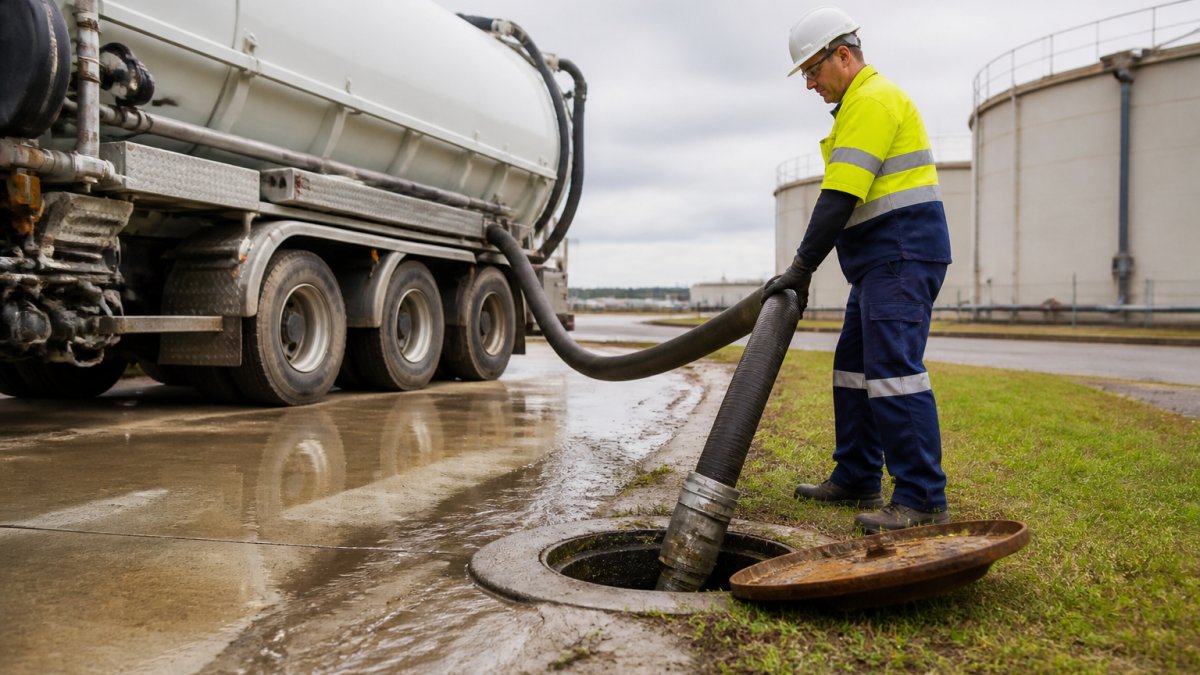
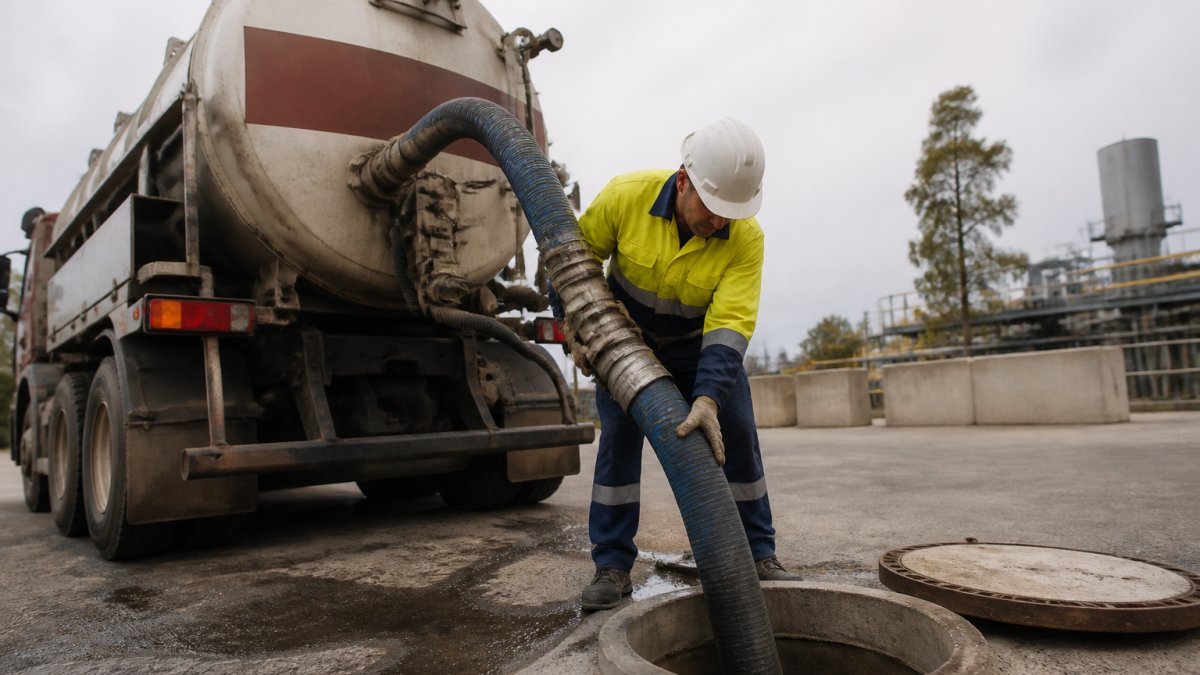
Liquid waste covers everything that pours: oily water from wash bays, coolant, sludge, holding tank and site toilet contents, and separator pit liquid.
If you run a wash bay or an oil separator, wash bay and oil separator cleaning covers how the pits and interceptors are emptied and cleaned properly.
Industrial Liquid Waste Removal for Wash Bays and Holding Tanks
Liquid waste is where most industrial sites get caught out, because it is invisible until a pit overflows or a separator stops working.
Three things decide how a liquid job runs:
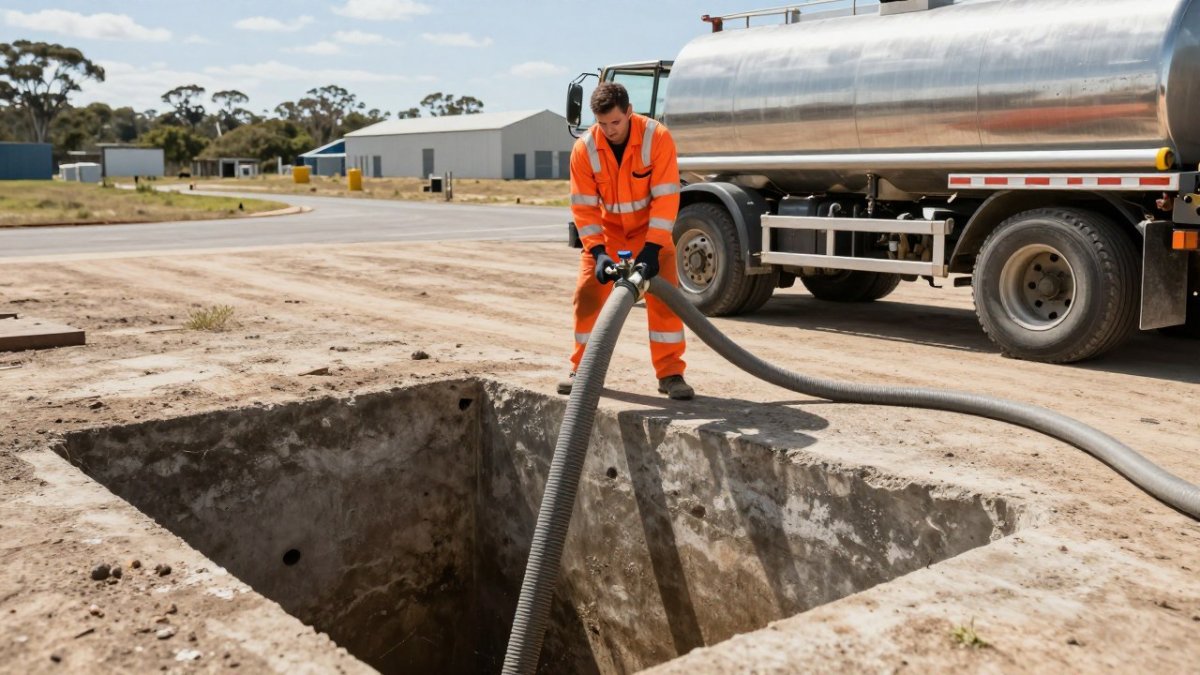
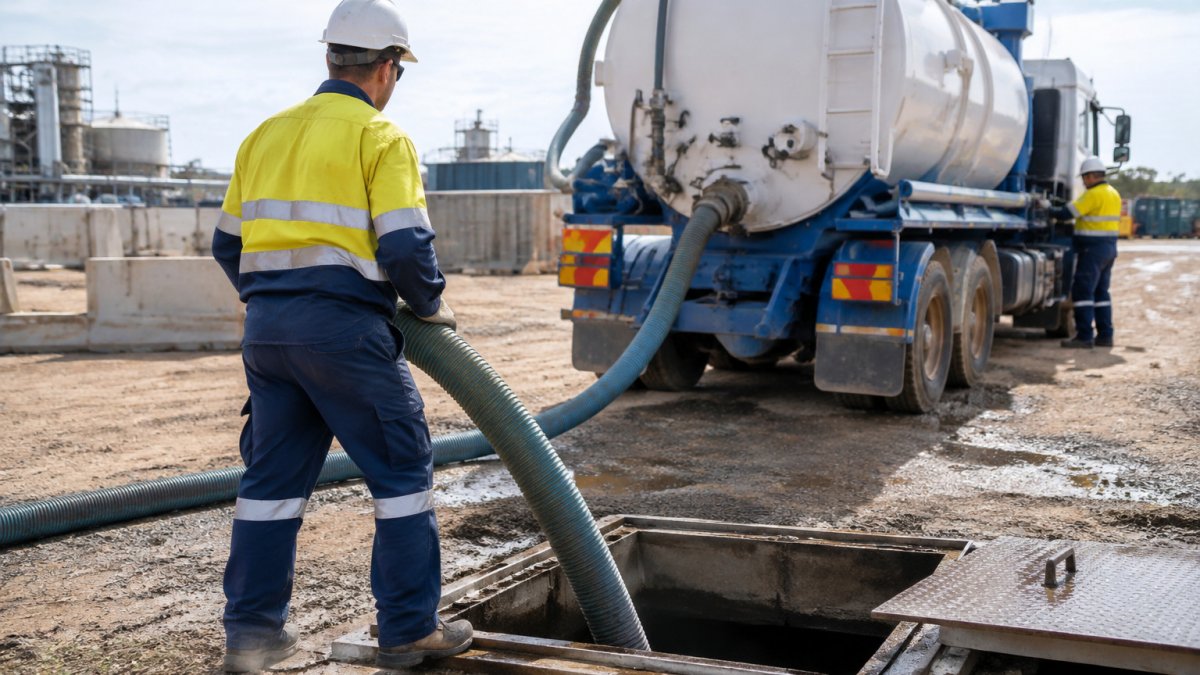
- Volume and access. A tank in the open pumps fast; a pit behind pipework needs a longer hose run.
- Contamination level. Oily water, coolant and sludge are handled and priced differently from clean water.
- Disposal route. Everything we pump goes to a licensed, environmentally friendly facility.
For bulk jobs, tank and pit cleaning, industrial liquid waste removal sets out what the service covers.
Watch out: a separator left too long fills with silt and oil, stops separating, and sends oily water straight to stormwater, an environmental incident, not a maintenance issue.
Industrial Bins, Skip Bins and Matching Bin Sizes to Your Volume
Bin size is a volume question, not a guess. Too small a bin means extra collections or waste on the ground; too large a bin on a tight site costs you access and floor space.
| Waste Stream | Typical Bin Type | What to Check Before Booking |
|---|---|---|
| General and mixed waste | Industrial metal bin or skip bin | Weekly volume and site access width |
| Scrap metal and timber | Dedicated skip bin | Separation from general waste |
| Liquid and sludge | Holding tank or pit, pumped out | Pump access and hose run |
| Hazardous and chemicals | Sealed, labelled containers | Licensed carrier and facility |
Match the bin to the stream first, then to volume. A steady daily trickle needs a smaller bin collected often; periodic cleanouts need a larger bin on call.
Building an Industrial Waste Collection Schedule That Holds
An industrial waste collection schedule is a written plan of what gets collected, how often, from where and by whom. A guessed frequency either over-services and wastes money or under-services and creates overflow, contamination and missed-run emergencies.
Step 1: Estimate volume per stream before you choose a frequency
You cannot size a schedule from a bin count alone. Estimate volume per stream using one of three methods, in order of accuracy:
- Weighbridge data. Use tonnage records per stream from disposal dockets, the most reliable input, and most industrial sites already have it.
- Bin volume x fill level. Record fill percentage at collection for two weeks.
- Generation-rate estimate. For liquid streams, estimate from tank capacity and pump-out interval. A 10,000 L tank pumped out monthly generates about 10,000 L per month, adjusted for top-up or rainfall ingress.
Measure for at least two weeks, ideally across a full production cycle if output is seasonal. A common pattern is a site that measures during a quiet fortnight, sizes the schedule to that, then overflows during peak production.
Step 2: Match the collection mode to the stream
Not every stream suits a scheduled run. Match the mode to how the waste is generated:
| Generation pattern | Suitable mode | Why |
|---|---|---|
| Steady daily or weekly output | Scheduled recurring collection | Predictable volume, predictable cost |
| Periodic cleanouts, shutdowns, project spikes | On-call or bulk collection | Avoids paying for empty bins between events |
| Liquid in holding tanks or pits | Scheduled pump-out or on-call when level triggers | Level-based triggers prevent overflow |
| Hazardous and chemically unstable waste | Scheduled with documented consignment | Tracking and storage limits apply |
A mixed site usually needs a hybrid: scheduled general waste, on-call bulk for cleanouts, and level-triggered pump-outs for liquid.
Step 3: Set the trigger, not just the frequency
A frequency alone ("weekly") fails when production rises. Pair every scheduled run with a trigger that brings the collection forward:
- Bin fill level reaching a set percentage (commonly 75-80%) before the scheduled run
- Liquid tank or pit reaching a marked level
- A production change, shutdown or project start that changes generation rate
Step 4: Name a site contact and define access
The most common cause of a missed collection is not the provider, it is a locked gate, a blocked hardstand or a bin that has been moved. The schedule should record:
- The named site contact who confirms access and signs off each collection
- Gate codes, weighbridge procedures and site induction requirements for the driver
- The hardstand or access route the truck needs, including turning circle and overhead clearance
Step 5: Review on a fixed cycle and after any change
Review the schedule quarterly, and immediately after any change in production, product mix, site layout or contractor. A schedule that was right at commissioning is often wrong twelve months later.
Watch out: reliability matters more than frequency. A missed liquid pump-out can stop work for days, and a missed general collection during a peak can breach storage limits.
What to put in the written schedule
A schedule that survives an audit and a staff change contains, at minimum:
- Each waste stream and its classification
- The container or tank assigned to each stream, with capacity
- Collection mode (scheduled, on-call, level-triggered) and frequency
That document is also the basis for a waste audit, which is covered in the construction and site audit section below.
Construction Site Waste Management: Segregation, Storage and Site Audits
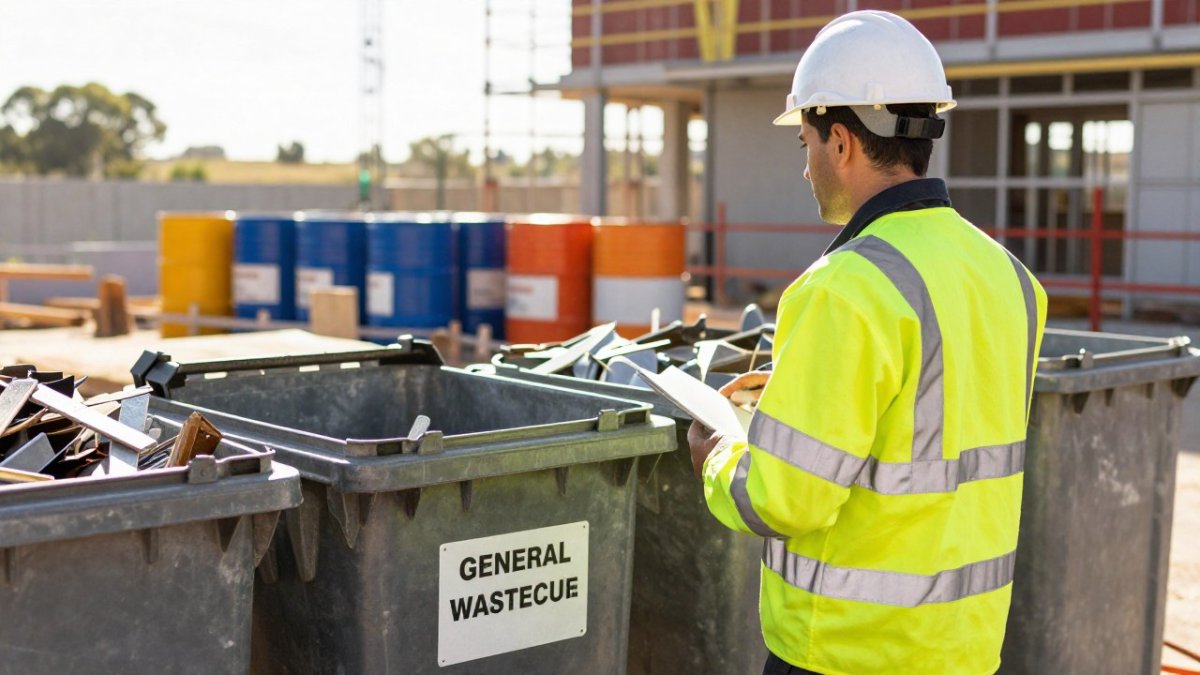
Construction site waste management starts with segregation at the point of generation. Separating general, recyclable, liquid and hazardous waste where it is created makes everything downstream cheaper and cleaner.
A practical site audit takes under an hour:
- Walk the site and list every waste stream you actually produce
- Check each bin is labelled and matched to its stream
- Confirm liquid containers are sealed and bunded
Run this monthly and after any change in scope. It is the cheapest compliance tool you have.
Hazardous Waste Disposal and Your Compliance Responsibilities
Hazardous waste disposal carries legal weight. Chemicals, oils, solvents, asbestos and contaminated materials must be classified, stored, transported and disposed of under Australian environmental law, and responsibility sits with the generator, not just the carrier.
The generator duty comes first
Under state and territory environmental protection legislation, the business that generates hazardous waste carries its own duties, which are not transferred to the carrier. In practice those duties usually include:
- Correctly classifying the waste before it leaves site
- Storing it safely in compatible containers
- Ensuring it is transported by a licensed carrier to a facility permitted to receive that waste type
A carrier's licence does not cure a misclassified load. If the waste is described wrongly on the paperwork, the generator remains exposed.
Classification is the first control
Hazardous waste is not a single category. It includes flammable liquids, oxidisers, corrosive substances, toxic materials, environmentally hazardous substances, and asbestos-containing material, among others. Classification drives container choice, segregation, transport placarding, facility acceptance and price.
If you are unsure how a waste is classified, ask before it is tipped or pumped.
Tracking documentation and consignment
Hazardous waste movements are tracked. Depending on the state or territory and the waste type, this typically involves a consignment or tracking document that records:
- The generator, the carrier and the receiving facility
- The waste type and classification
- The quantity and container type
The generator, carrier and facility each keep a copy. Retain yours for the period your state regulator requires as evidence the waste went where it was supposed to. A missing consignment record is one of the easiest compliance failures for a regulator to find.
Transport and facility requirements
Hazardous waste must move with a carrier licensed for that waste type, in a vehicle and container configuration suited to the hazard, with the required placarding and documentation. The receiving facility must be permitted to accept that specific waste, a general waste facility is not permitted for hazardous waste, and a facility permitted for one hazardous category may not accept another.
Many sites use the same carrier for years without ever confirming the receiving facility's permit scope.
On-site storage before collection
Storage is where most generator-side incidents originate. Practical controls:
- Store hazardous waste in sealed, labelled containers compatible with the substance
- Use bunding sized to contain a spill from the largest container, or the aggregate where required
- Keep incompatible wastes segregated, oxidisers away from flammables, acids away from bases, everything away from drains
Watch out: a container labelled only "waste" or "chemicals" is a classification failure waiting to happen. If the label does not identify the substance and its hazard, the carrier cannot verify the load and the facility can reject it.
Asbestos and contaminated material
Asbestos-containing material and contaminated soil carry additional state and territory requirements, including specific handling, packaging, transport and disposal controls, and sometimes notification or licensing. Do not treat asbestos as a general hazardous load. Confirm requirements with your regulator before removal begins, and use a carrier and facility specifically permitted for asbestos.
What to keep on file
A defensible hazardous waste file contains, for each stream:
- The classification record and any supporting analysis
- The safety data sheet or equivalent for the substance
- The carrier's licence and the receiving facility's permit
That file is what you produce if a regulator asks, and what you need if a load is questioned at the gate. Build it before the first collection, not after the first incident.
What Drives Cost and How to Keep Disposal Spend Down
Disposal cost comes down to four things: volume, waste type, access and frequency. Hazardous and liquid waste cost more to handle than general waste. Tight access and long hose runs add time. Frequent small collections cost more per litre than planned bulk runs.
Ways to keep spend down:
- Segregate properly. Contaminated loads get re-priced as higher-risk waste.
- Right-size the bin. Oversized bins and over-servicing are silent budget leaks.
- Book planned runs. Scheduled collections beat emergency callouts on price.
We aim to give straight quotes with no hidden surprises. Pricing depends on quantity, dates and delivery, so ask us for a quote. When you are ready, get a quote or book a job and we will price it against your actual volumes.
Frequently Asked Questions
What types of waste are generated on industrial sites?
Most industrial sites produce a mix of general waste (packaging, timber, scrap metal, office refuse), liquid waste (wash bay runoff, oily water, coolant, sludge from oil separators and holding tanks), and hazardous waste (chemicals, solvents, oils, asbestos-containing material). The mix changes with the work: a maintenance workshop leans heavily on oily water and coolant, while a construction site generates more general and construction waste. Sorting each stream before pickup keeps loads legal and usually lowers disposal costs.
How often should industrial waste be collected?
Collection frequency should follow your actual volume, not a fixed calendar. Sites with high daily output often need several general waste pickups a week, while smaller workshops may only need a tank emptied every few months. Build your industrial waste collection schedule around measured volumes from a site audit, then review it each quarter. If bins are overflowing before pickup, or half empty at every visit, the frequency is wrong.
What is the difference between general, liquid and hazardous industrial waste?
General waste is everyday solid refuse that goes to landfill or recycling. Liquid waste covers pumpable material such as wash bay water, oily water, coolant and septic or holding tank contents, which needs a vacuum truck and disposal at a licensed facility. Hazardous waste is anything with a risk profile, including chemicals, solvents, oils and asbestos, and it carries extra storage, transport and record-keeping duties. Each stream needs its own bins, its own paperwork and often its own provider.
What records should a business keep when waste is removed?
Keep the waste transport certificate or tracking document for every load that leaves your site, plus the receiving facility's confirmation that it was accepted. Store these with any manifests for hazardous or liquid loads. Regulators can ask to see them, and they also protect you if a load is later questioned. A simple folder per site, physical or digital, with every certificate filed the day it's issued, is enough.
How can industrial sites reduce waste disposal costs?
Start with a waste audit to find out what you're actually throwing away and how much. Segregate streams properly so recyclable metal, cardboard and clean timber stay out of general waste, because landfill is the most expensive destination. Right-size bins so you're not paying for empty air, and match collection frequency to real volume. Fix leaks and spills at the source, and keep oil separators maintained so liquid loads stay small. Pricing depends on quantity, dates and delivery, so ask us for a quote.
How can construction and industrial sites manage liquid waste safely?
Contain it first: bunded storage, sealed holding tanks and wash bays plumbed to a capture point rather than a stormwater drain. Label tanks clearly and keep incompatible liquids apart. Use a licensed operator with vacuum trucks for pump-outs, and confirm where the load is going, because disposal must happen at a licensed facility. Keep the transport certificates on file.
Waste removal for industrial sites only works when the streams, the bins, the schedule and the paperwork all line up. If liquid waste is the part that keeps slipping, Kwinana Site Services can take it off your plate with bulk pump-outs, tank and pit cleaning, and disposal at licensed facilities, backed by 18 years in WA and a promise to turn up when we say we will. Get started with Kwinana Site Services and keep your site clean, compliant and running without the fuss.