 how-to
How to Avoid Hidden Waste Fees on Your Site Pump-Out
Last Updated: November 1, 2026
Quick Summary
To avoid hidden waste fees, ask for a written, itemised quote that lists every charge before you book. Confirm whether disposal, call-out and travel are included, ask about minimum charges and extra volume rates, and compare the total cost of each quote with all fees included.
- Ask exactly what the quote covers, including whether disposal is included or charged separately.
- Check call-out and travel charges, and ask about after-hours or weekend surcharges.
- Confirm the minimum charge and how extra volume is priced before you agree.
- Compare quotes like for like on one page, using the total cost of a realistic job.
- Get the terms in writing, since a verbal estimate can change on the day.
Table of Contents
- Step 1: Ask What the Quote Actually Includes
- Step 2: Check the Call-Out Fee and Travel Charges
- Step 3: Put Your Questions to the Contractor
- Step 4: Compare Quotes Like for Like
- Step 5: Understand the Real Cost of a Site Pump-Out
- Booking Your Next Pump-Out Without the Surprises
- Frequently Asked Questions
A cheap quote for a site pump-out often becomes an expensive bill.
Hidden waste fees are extra charges that appear after the job starts or at the end of it. They are not always wrong. Some are legitimate costs.
Most of the surprises come from three places:
- Disposal fees charged by the facility that takes the waste
- Call-out and travel charges added on top of the job price
- Minimum charges and volume limits that were not explained up front
Knowing where these come from is the first step to avoiding them. The steps below show you what to ask and what to compare.
Step 1: Ask What the Quote Actually Includes
Start by asking exactly what the quote covers. A quote that looks low may only include the pump-out itself. Disposal, transport and cleaning can be extra.
Ask the provider to list every line item. Good questions include:
- Does this price include disposal at the facility?
- Is there a separate charge for the waste itself?
- Is the price per load, per hour or per tonne?
Disposal fees and where the waste is taken
Disposal is one of the largest costs. Ask where the waste goes and how it is charged. Disposal may be included in the job price or charged as a separate line, depending on the provider.
A clear provider will tell you the disposal site and the charge. If they cannot say where the waste goes, treat that as a warning sign.
Minimum charges, tonnage and volume limits
Many quotes include a minimum charge. This means you pay a set amount even if the tank is only partly full. Ask what the minimum is before you agree.
Ask about volume limits too. If your tank holds more than the quoted volume, the extra may be billed at a higher rate. Confirm the tank size and ask how extra volume is priced.
Step 2: Check the Call-Out Fee and Travel Charges
Many hidden costs come from call-out fees and travel charges. These can be added on top of the job price without much warning.
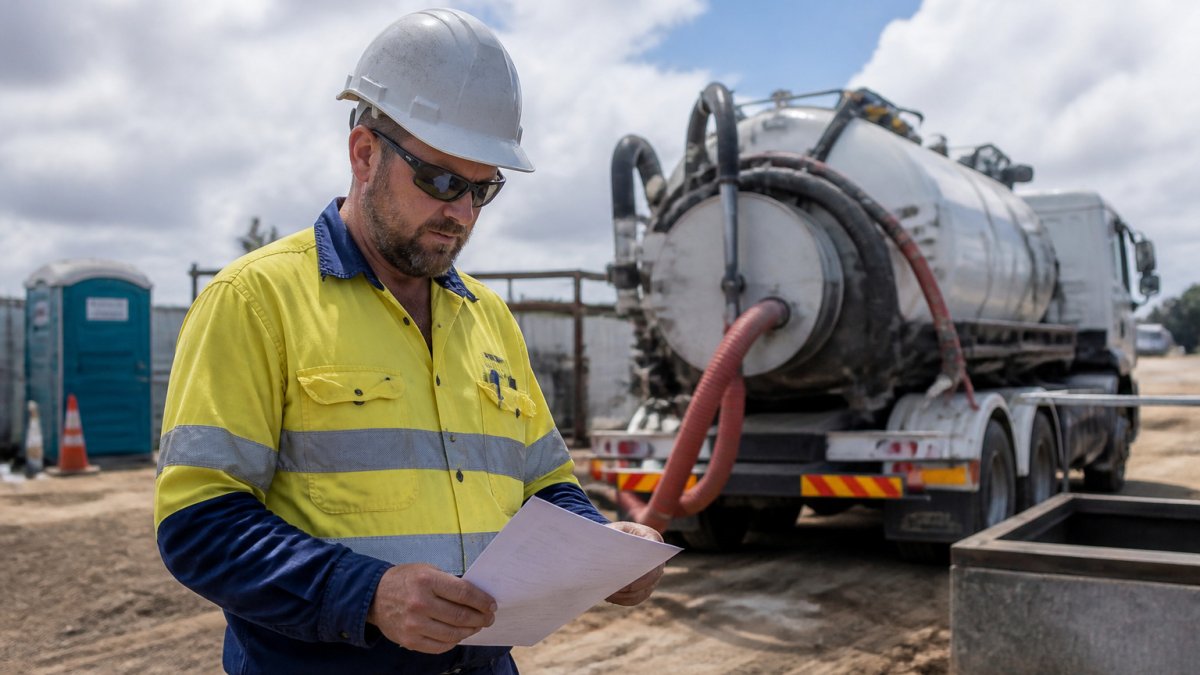
Ask these questions before you book:
- Is there a call-out fee, and how much is it?
- Are travel charges included, or charged by distance?
- Is there a surcharge for after-hours or weekend jobs?
A simple way to check is to ask for the total cost of a standard job, with all fees included. Write it down and compare it with the final invoice.
Site managers often see a travel charge added once the truck is already on the way.
Step 3: Put Your Questions to the Contractor
Before you book, put a short list of questions to the contractor. Their answers tell you a lot about how they price their work.
Use this checklist:
- What is included in the quoted price?
- Is disposal included, and where does the waste go?
- What is the call-out fee, if any?
A reliable provider will answer these without fuss. If the answers are vague, ask again or get another quote.
Watch out: a quote that is only a verbal estimate can change on the day. Ask for the terms in writing before you book.
Step 4: Compare Quotes Like for Like
Comparing quotes is only useful if they cover the same work. Two prices can look very different because they include different items, use different units, or bury a minimum charge in the fine print. A practical approach is to put every quote onto one page before you decide.
Build a one-page comparison sheet
Set up a simple table with one column per provider and the same rows for every quote.
| Row to capture | What to write down |
|---|---|
| Unit of pricing | Per load, per tonne, per hour, or per tank, and the size of that unit |
| Base price | The headline number, excluding GST |
| GST | Confirm whether the quote is inclusive or exclusive |
| Included volume or weight | How much waste is covered before overage applies |
| Overage rate | The rate per extra tonne, cubic metre, or hour |
| Minimum charge | The floor you pay even on a small job |
| Call-out fee | Flat fee, or included |
| Travel charge | Included, per kilometre, or zoned |
| Disposal or tip fee | Included, or passed through at cost |
| Waiting or standby rate | Per hour, after how many minutes |
| After-hours or weekend surcharge | Percentage or flat amount |
| Access or difficult-site fee | Steps, long hose runs, restricted entry |
| Payment terms | Due date, card surcharge, late fee |
Normalise to a single number
Once the rows are filled, calculate a like-for-like total for a realistic job, not the smallest possible job. Use your actual tank size, your actual access, and your actual timing.
A simple method:
- Estimate your volume or weight.
- Subtract the included volume from each quote.
- Multiply any excess by that provider's overage rate.
- Add the base price, call-out, travel, disposal (if separate), and any surcharge that applies to your job.
- Add GST if the quote was exclusive.
The provider with the lowest normalised total is usually the best value, not necessarily the one with the lowest headline number.
Watch for unit mismatches
A per-hour quote and a per-load quote cannot be compared directly. Ask a per-hour provider for a typical job duration and convert it to a per-job figure. Ask a per-load provider what happens if the load is part-full.
Keep the sheet as your record
Save the completed comparison sheet with the written quotes attached. If the final invoice later includes a line that was not on the sheet, you have a clear, dated record of what was agreed.
ACCC guidance on misleading pricing and component pricing
Step 5: Understand the Real Cost of a Site Pump-Out
The real cost of a pump-out is the total you pay at the end of the job, not the number at the top of the quote. But knowing which extras are legitimate and which are a warning sign is what separates a fair invoice from a disputed one.
Work the sum, don't estimate it
Add these together for a realistic job:
- Base job price
- Call-out and travel charges
- Disposal or tip fee
Do this for each quote on your comparison sheet. The total is the only number worth comparing.
Legitimate fees versus warning signs
Not every extra is a hidden fee. Some are standard costs that a fair provider will disclose up front. The distinction is disclosure, not the charge itself.
| Usually legitimate if disclosed | Warning signs |
|---|---|
| Disposal or tip fee passed through at cost | Disposal fee that appears only on the final invoice |
| Call-out fee stated in the quote | Call-out fee described as 'admin' or 'compliance' after the job |
| Overage rate per tonne or cubic metre | Overage rate not stated, then applied at a premium |
| After-hours surcharge for weekend work | Surcharge applied to a weekday job without explanation |
| Waiting time after a stated grace period | Waiting time charged from arrival, with no grace period |
| Access fee for stairs or long hose runs | Access fee invented on site with no prior mention |
| Card surcharge within permitted limits | Card surcharge above the cost of acceptance |
A charge that was disclosed in writing before the job is not hidden, even if it is unwelcome. A charge that appears for the first time on the invoice is the one to challenge.
Consumer rights and dispute steps
If the final invoice includes a charge that was not in the written quote, you are not obliged to simply pay it. Under the Australian Consumer Law, a business must not make false or misleading representations about the price of services. The ACCC publishes guidance on misleading pricing and on component pricing that is worth reading before you dispute.
A practical escalation path:
- Ask for an itemised invoice. Request a written breakdown of every line, with the rate and the quantity.
- Compare it to the written quote. Highlight any line that was not disclosed.
- Put your dispute in writing. State the quoted price, the invoiced price, and the specific lines you are challenging. Keep it factual.
- Ask for the charge to be withdrawn or explained. Give the provider a reasonable deadline to respond.
- Escalate if unresolved. Contact your state or territory consumer affairs body, or the ACCC for misleading pricing conduct. For disputes about the service itself, the relevant industry or small claims process may apply.
Reduce the real cost, not just the headline
There are legitimate ways to lower the total:
- Sort before the pump-out. Keep the tank to the waste stream it is meant for.
- Reduce volume where possible. Fewer unnecessary flushes, fixing leaks, and avoiding stormwater ingress all reduce the volume you pay to dispose of.
- Book regular runs. Regular scheduled runs can make planning easier and are worth raising when you request a quote.
Pricing depends on site location, tank size, waste type, access, and frequency. For current prices, contact Kwinana Site Services for a quote based on your site and ask for the full cost in writing.
ACCC guidance on false or misleading claims about price
Booking Your Next Pump-Out Without the Surprises
Use the steps above before you commit.
When you are ready to book, request a quote for a site toilet or holding tank pump-out and ask for the full cost in writing. You can also get a quote or book a job.
If your waste is industrial rather than site toilet waste, check how our industrial liquid waste removal works before you book.
Frequently Asked Questions
How can I avoid hidden fees on a site pump-out? Ask for a full breakdown of the quote before you book.
Is a cheap quote always the best choice? Not always. A low quote may leave out disposal or travel.
Should I ask for a written quote? Yes. A written quote gives you a clear record of what was agreed.
Frequently Asked Questions
What fees can be added to a waste removal quote?
Beyond the base price, waste removal quotes can include a call-out or mobilisation fee, travel charges, disposal or tip fees at the receiving facility, minimum charges for small jobs, waiting time if the truck is held on site, and extra charges for difficult access or after-hours work. Some contractors also add a fuel or environmental surcharge. None of these are unusual by themselves, but they should be listed in writing before you book. Ask for each one by name so you can compare quotes on the same basis.
How can I check whether a waste contractor's quote includes disposal fees?
Ask directly whether disposal or tip fees are included in the price and, if not, how they are charged. A quote that says 'per load' should state what counts as a load. Ask which facility the waste will go to and whether its fees are passed through at cost or marked up. A clear written answer is a good sign. If the contractor says disposal is 'sorted out later', ask for that in writing before the job starts.
What should I ask before booking a site pump-out?
Confirm the call-out fee, the minimum charge, how volume is measured, whether disposal is included, and what happens if the truck waits on site or cannot reach the tank. Ask for a guaranteed arrival window and what the contractor charges if they miss it. Check that the waste will be taken to a licensed facility and ask how you can verify the disposal record. Finally, ask whether the price changes for after-hours or urgent callouts.
How do I compare waste removal quotes fairly?
Write down the same scope for each contractor: the volume or number of loads, the waste type, the site address, the access conditions and the disposal facility. Ask every contractor to price that exact scope and to list all add-ons separately. Then compare the total landed cost, not the headline rate. A quote that looks cheaper may leave out the call-out fee or disposal charge that another quote includes.