 how-to
Managing Liquid Waste Across Multiple Sites Step by Step
Quick Summary
Managing liquid waste across multiple sites works best with one shared system: a standard management plan for each site, a collection schedule based on real tank fill rates, and one consolidated record of every pump-out. Assign a named owner to each site and review the records monthly to catch problems early.
- Use one plan template for every site, covering site details, waste inventory, storage, collections, records and spill response.
- Set each site's collection schedule from measured tank fill rates, and book pump-outs before tanks reach a safe level.
- Keep all collection dockets, disposal certificates and incident records in one central register tagged by site ID.
- Review on-time collections, average tank level at collection and unplanned call-outs for each site every month.
- Ask every provider for a written quote listing disposal fees, travel, call-out and after-hours charges before the first job.
Table of Contents
- Why Multi-Site Liquid Waste Gets Out of Control
- Step 1: Build a Liquid Waste Management Plan for Every Site
- Step 2: Set a Liquid Waste Collection Schedule That Fits Each Site
- Step 3: Set Up Liquid Waste Tracking and Records Across Sites
- Coordinating Bulk Liquid Waste Pump-Outs and Service Providers
- Measuring Site Performance and Handling Urgent Call-Outs
- Booking Your Next Pump-Out Across Your Sites
- Frequently Asked Questions
Why Multi-Site Liquid Waste Gets Out of Control
Last Updated: November 12, 2026
Running liquid waste across several sites sounds simple until trucks turn up at the wrong times.
Liquid waste management is the process of collecting, storing, transporting and disposing of wastewater, oily water, sludge and other liquid waste safely and legally.
Most multi-site problems come from three places:
- Each site runs its own system. One supervisor books pump-outs by phone, another uses a spreadsheet, and a third waits until the tank overflows.
- Nobody owns the records. Waste dockets end up in site offices or email inboxes, which makes audits and reporting painful.
- Costs and schedules drift apart. Without a common plan, some sites are pumped too often and others too rarely.
The fix is practical: treat each site as part of one system, with a clear plan, schedule, tracking method and regular checks.
Step 1: Build a Liquid Waste Management Plan for Every Site
A liquid waste management plan is a short written document setting out what waste each site produces, where it is stored, who handles it and how it leaves the property.
Use one template for every site. A workable plan has six parts:
- Site details, site name, address, operating hours, access restrictions (gate codes, inductions, load limits) and the named site contact.
- Waste inventory, every liquid waste stream, its source, storage method, capacity and fill rate.
- Storage and containment, tank or container type, bunding, signage, and the level at which a collection must be booked.
- Collection arrangements, provider, service frequency, booking method and escalation contact.
- Records and responsibilities, who signs dockets, where records are stored and who reviews them.
- Spill and emergency response, kit location, drain protection, who to call and how the incident is reported.
Start by listing the waste streams on each site. Common examples include:
- Portable toilet and site toilet waste
- Holding tank contents
- Wash bay water and oily water
- Coolant and workshop liquids
For each stream, note the storage method, the approximate volume and how often it builds up. This gives you a baseline you can use when you set collection frequency later.
Site-Level Waste Inventories and Multi-Site Audits
A site-level waste inventory lists every liquid waste source on one site, with its location, container or tank size and current status.
Build the inventory as a table with these columns, and use the same columns at every site:
| Field | What to record |
|---|---|
| Stream ID | A short code, e.g. ST-01 for site toilet waste |
| Source | Where the waste is generated |
| Storage | Tank, pit, drum or separator, with capacity in litres |
| Fill rate | Approximate litres per week, or the observed level at each check |
| Collection trigger | The level or date at which a pump-out is booked |
| Provider | Who currently services it |
| Risk | Spill risk, odour, hazardous classification, proximity to drains |
| Status | Current, redundant, or unrecorded |
Once every inventory is done, run a multi-site audit. Put all the inventories side by side and look for:
- Sites with waste sources nobody has written down
- Tanks that are much larger or smaller than the site needs
- Sites where waste is stored in containers that don't meet the site's requirements
- Streams with no assigned provider or no collection trigger
Score each finding as high, medium or low risk, and give every high-risk finding a named owner and due date. A finding without an owner is a note, not an action.
Don't treat the audit as a one-off paperwork exercise.
Assigning Roles, Responsibilities and Staff Training
Every site plan needs a named person responsible for liquid waste.
Write down who does what:
- Site supervisor: Checks tank levels, books pump-outs and signs off collections.
- Site staff: Report leaks, spills or full tanks straight away.
- Head office or manager: Reviews records, approves schedule changes, qualifies providers and handles provider issues.
- Central waste coordinator (where volumes justify it): Owns the shared template, consolidates records and runs the audit cycle.
Train staff on what can and cannot go into each tank or container, what to do in a spill, and where emergency contacts are kept.
Watch out: if the central coordinator role is left vacant or shared informally, the audit cycle and record consolidation quietly stop, and the sites drift back to running their own systems.
Step 2: Set a Liquid Waste Collection Schedule That Fits Each Site
A collection schedule sets how often each site's liquid waste is removed.
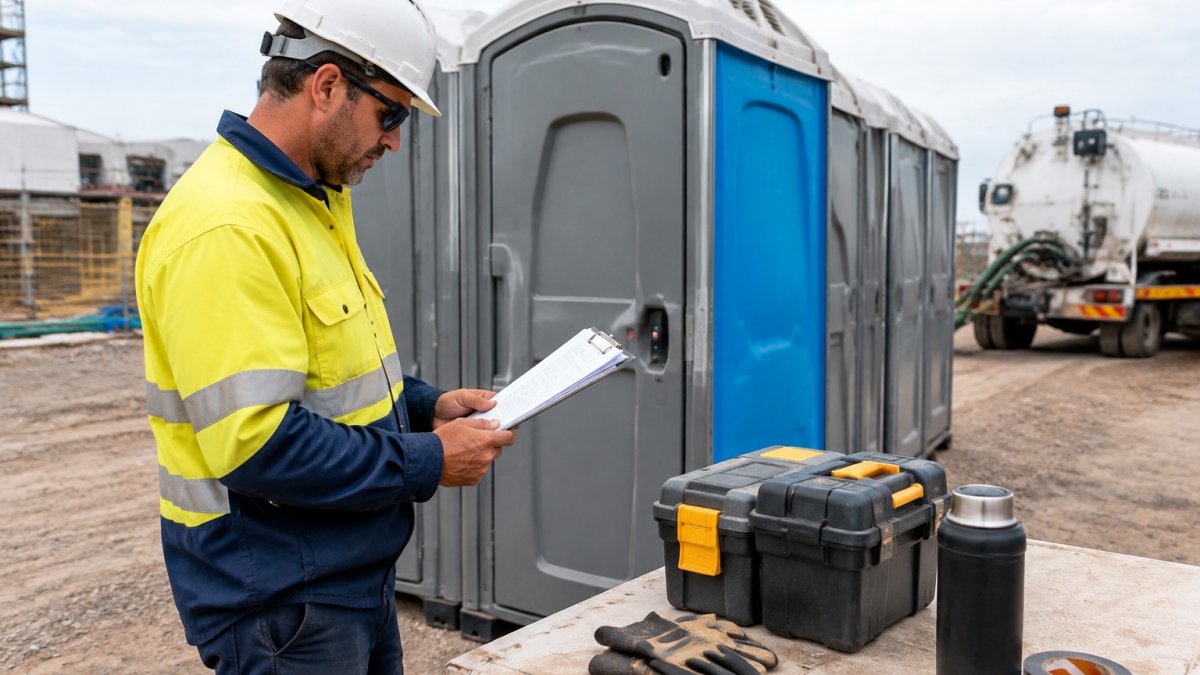
Base each schedule on real inventory data.
Use a simple rule for each site:
- Regular runs: Sites with steady output, such as a construction site with ongoing portable toilets, get a fixed weekly or fortnightly run.
- One-off or event jobs: Sites with short bursts of waste, such as an event, get booked collections around the event dates.
- Irregular or occasional sites: Small workshops with one tank may only need a collection every couple of months. Check the level on a fixed date so nothing is missed.
Put the schedule in one shared calendar that the site supervisor and head office can both see. Changes should be recorded the same day.
Pricing depends on volume, distance, frequency and disposal requirements. Ask for a quote for each site so you can compare like with like.
Step 3: Set Up Liquid Waste Tracking and Records Across Sites
Tracking turns a collection into evidence. Every pump-out should leave a record of what was removed, from where, by whom, and where it was taken. Across multiple sites, the harder problem is consolidating records into one view while still tracing any single collection back to a specific site, tank and date.
Use the same record format at every site. A workable record includes:
- The site name and address
- The date and time of collection
- The type and approximate volume of waste
- The provider's name and vehicle details
- The disposal facility the waste went to
- The signature of the person who supervised the job
Consolidating Manifests, Certificates and Incidents
A multi-site register should hold four record types, each tagged with a site ID so it can be filtered by location:
- Collection dockets and manifests, one entry per pump-out, linked to the stream ID from the site inventory.
- Disposal certificates, the facility's confirmation of what was received and how it was treated or disposed of.
- Incidents, spills, overflows, missed collections and near misses, with cause and corrective action.
- Provider records, contracts, insurance certificates, licences and service-level terms.
Keep these in one central place rather than on each site. A shared folder or simple register works well, provided it is backed up, everyone uses the same naming system, and each entry carries the site ID.
Retain records for the period your environmental regulator and contracts require, and check that period before archiving anything.
Regular reporting is the other half of tracking. Each month, check that:
- Every planned collection happened
- Every collection has a matching docket and, where required, a disposal certificate
- Any missed or late collections are explained and followed up
- Every incident has a recorded cause and a closed corrective action
Good records make audits, compliance checks and insurance claims far easier, and let you compare sites on evidence rather than impression.
Comparing Site Performance with Useful Measures
Once records are consolidated, a small set of measures shows which sites are outliers. Track these monthly and review them side by side:
- Collections on time: the percentage of planned pump-outs that happened on the scheduled date.
- Average tank level at collection: shows whether a site is collected too early or too late.
- Unplanned call-outs per site: a high number points to a schedule or tank-size problem.
- Recycling or recovery rate: the share of liquid waste diverted from disposal where a recovery route exists.
- Incidents per site: spills, overflows and near misses, with severity noted.
A site consistently different from the rest usually has a specific cause, heavy use, an old tank, a change in operations or a supervisor who needs more training.
Watch out: consolidating records into a head-office spreadsheet while leaving the original dockets on site creates two versions of the truth, and the gap is exactly what an auditor will find first.
Coordinating Bulk Liquid Waste Pump-Outs and Service Providers
Most multi-site operations use more than one provider, a site toilet company for one location, an industrial waste carrier for another, a specialist for oily water.
Build a provider list recording which services each offers, which sites they cover, their response times and the contact for urgent callouts.
When booking bulk pump-outs, group sites by area where possible, pumping several sites in one trip can reduce travel time and cost.
Watch out: a quote that looks cheap can rise once extra charges are added.
Measuring Site Performance and Handling Urgent Call-Outs
Once the system is running, measure it. A few simple numbers show whether each site is on track:
- Collections on time: Percentage of planned pump-outs that happened on the scheduled date.
- Average tank level at collection: Shows whether you are collecting too early or too late.
- Unplanned call-outs per site: A high number means the schedule or the tank size needs review.
- Cost per litre or per collection: Lets you compare sites fairly.
Compare these figures across sites every month. A site consistently different from the rest usually has a specific cause, such as heavy use, an old tank or a supervisor who needs more training.
Urgent call-outs will still happen, a tank can fill early after heavy rain or a busy week. Agree an urgent call-out process before it is needed, naming who can request an urgent job, the expected response time and how the cost is approved.
Booking Your Next Pump-Out Across Your Sites
If you manage liquid waste for several sites, the easiest next step is to put these three steps in place this month: a plan for each site, a collection schedule, and one shared tracking record. Then book your first coordinated run.
Kwinana Site Services handles bulk liquid waste removal across Perth, including site toilet and holding tank pump-outs for construction, events and commercial sites. Request a quote for your sites.
Frequently Asked Questions
How do you manage liquid waste across multiple sites?
Start with a written plan that covers every site, then record what each site produces, how it is stored and who arranges collection. Use a single schedule and one set of records so you can see volumes and disposal dates in one place. Assign one person to oversee the whole process and train site staff on segregation and reporting. Review the plan regularly, because the waste profile of a site can change as work progresses.
How often should liquid waste be collected from a worksite?
Collection frequency depends on how fast each tank or sump fills, the type of waste and the activity on site. A workshop with one tank might only need a pump-out every couple of months, while a busy construction or event site may need regular runs. Check fill levels on a set cadence and adjust the schedule when volumes change. Kwinana Site Services can discuss a schedule for your sites when you request a quote.
How can a business check that liquid waste is disposed of correctly?
Ask your provider for disposal documentation for every load, showing what was collected and where it was taken. Keep these records with your site tracking so you can match collections to volumes. Confirm the disposal facility is licensed to receive the waste type you produce. Regular internal checks against your records help you spot gaps before they become compliance problems.
What factors affect the cost of bulk liquid waste pump-outs?
Pricing depends on quantity, the type of waste, access to the site, timing and whether the job is regular or one-off. Urgent call-outs and distance can also change the cost. For current prices, request a quote from Kwinana Site Services on your website, where you can describe your sites and volumes.