 ultimate-guide
How Licensed Liquid Waste Disposal Facilities Work
Last Updated: October 28, 2026
Quick Summary
A licensed liquid waste disposal facility is a site approved by the environmental regulator to receive, treat and dispose of liquid waste streams under defined permit conditions. Those conditions set out which waste types the facility may accept, how waste must be stored and treated, and what monitoring and reporting applies. In Western Australia, every facility holds a licence under the Environmental Protection Act 1994 that you can confirm against the public register.
- Check both the carrier's licence and the receiving facility's licence for every load.
- Confirm a facility's licence number against the public register maintained by the Department of Water and Environmental Regulation.
- Record the licence number, the date you checked it and the waste categories you confirmed as your evidence.
- Expect sampling and analysis at the gate, since a failed load returns to the generator and you pay for the trip.
- Separating coolant from general wash-down water keeps volume down and makes disposal cost predictable.
Table of Contents
- What a Licensed Liquid Waste Disposal Facility Actually Is
- How to Verify a Facility's Licence and Permitted Waste Types
- Waste Classification and Acceptance Criteria at the Gate
- Oily Water Disposal and Workshop Coolant Disposal: What Facilities Accept
- Liquid Waste Transport: From Your Tank to the Treatment Plant
- Waste Disposal Documentation and Generator Responsibilities
- What Drives Disposal Costs and How to Prepare a Compliant Delivery
- Get a Quote for Licensed Liquid Waste Disposal
- Frequently Asked Questions
What a Licensed Liquid Waste Disposal Facility Actually Is
A licensed liquid waste disposal facility is a site approved by the environmental regulator to receive, treat and dispose of liquid waste streams under a defined set of permit conditions. Those conditions set out exactly which waste types the facility may accept, how the waste must be stored and treated, and what monitoring and reporting applies. A facility that isn't permitted for your waste stream can create a liability for the waste generator.
The licence is the whole point. A facility without one is just a hole in the ground with a hose.
Licensed Facility vs Licensed Carrier: Why Both Matter
Two separate approvals sit behind every compliant load. The carrier must be licensed to transport controlled waste, and the receiving facility must be licensed to accept that specific classification. A licensed carrier delivering to an unlicensed site is still a problem, and a licensed facility receiving from an unlicensed carrier is equally exposed. Check both, every time, and keep the paperwork for both.
How to Verify a Facility's Licence and Permitted Waste Types
Verification is straightforward if you know where to look, and most waste generators never do it. Every facility operating in Western Australia holds a licence issued under the Environmental Protection Act 1994, and that licence is a public document. Ask the facility or your carrier for the licence number, then confirm it against the public register maintained by the Department of Water and Environmental Regulation. The register lists the licence holder, the premises, the approved waste categories and any conditions attached.
What to Confirm Before You Book a Delivery
Keep a record of the licence number, the date you checked it and the waste categories you confirmed. If an inspector or a customer asks you to prove the destination was authorised for that stream, that record is your evidence.
Here is what to confirm and record before booking a delivery.
| Item | What to confirm | Note |
|---|---|---|
| Licence number | Ask facility or carrier for it | Confirm against public register |
| Licence holder and premises | Listed on the public register | Licence is a public document |
| Approved waste categories | Categories the facility may accept | Match to your waste stream |
| Conditions attached | Any conditions on the licence | Listed on the register |
| Your record | Licence number, date checked, categories confirmed | Your evidence of authorised destination |
Waste Classification and Acceptance Criteria at the Gate
Facilities test. Expect sampling and analysis before a load is accepted, particularly for tanker deliveries of industrial waste where the source is variable. Watch out: a load that fails acceptance at the gate usually goes back to the generator, and you pay for the failed trip on top of the disposal. Get your stream classified correctly before it leaves your site.
Oily Water Disposal and Workshop Coolant Disposal: What Facilities Accept
Our wash bay and oil separator cleaning service covers the collection side of both streams, including separator and triple interceptor waste.
Workshop Coolant Disposal and Why It Needs Separating
Coolant degrades. Tramp oil, swarf and bacterial growth build up in a sump until the fluid stops doing its job, and dumping it down a trade waste drain breaches the conditions most workshops operate under. Separating coolant from general wash-down water keeps the volume down, keeps the classification clean, and makes the disposal cost predictable rather than a surprise at the end of the quarter.
Liquid Waste Transport: From Your Tank to the Treatment Plant
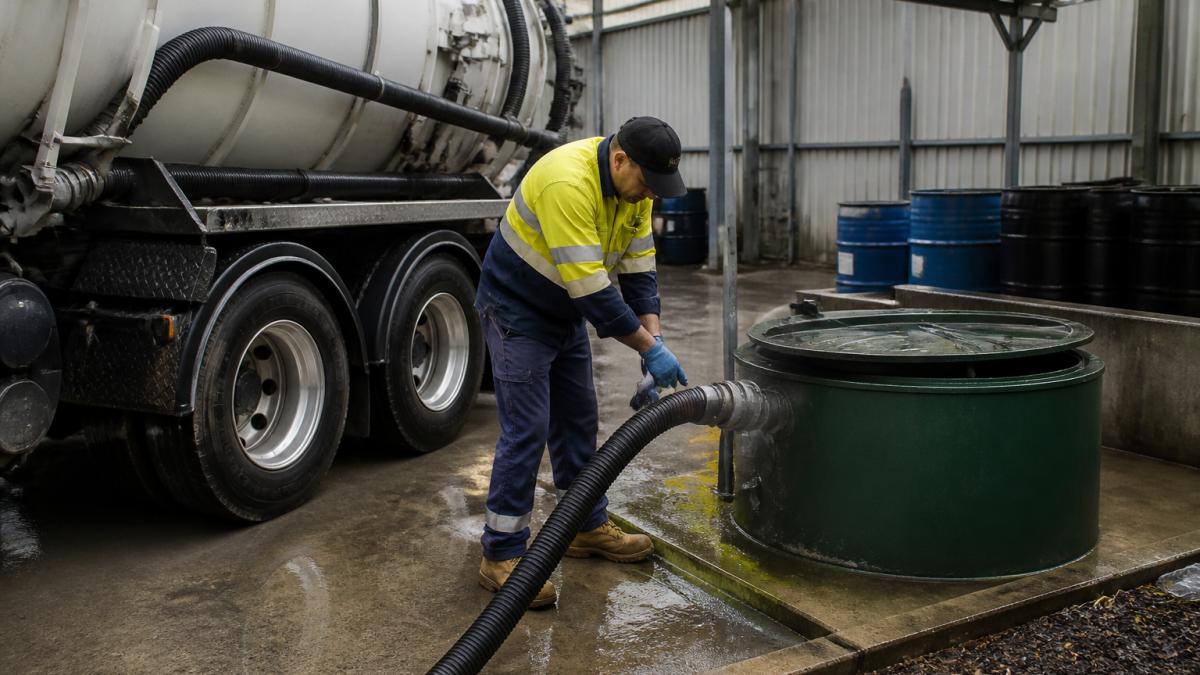
For sites running portable toilets or holding tanks, we handle the collection run through our site toilet and holding tank pump outs service.
Waste Disposal Documentation and Generator Responsibilities
- Send the waste to an authorised destination. The receiving facility must be licensed to accept that specific waste classification, and you should be able to show that you checked.
The Documents That Should Follow Every Load
- Disposal or treatment confirmation. Evidence of how the waste was treated or disposed of, where the facility provides it.
A Practical Documentation Checklist
If an inspector asks where a load went, "the truck took it" is not an answer. The documentation is what proves the waste reached a licensed facility and was handled lawfully, and it is also what protects you if a carrier or facility later turns out to have been non-compliant.
What Drives Disposal Costs and How to Prepare a Compliant Delivery
Disposal costs vary with the waste classification, the volume, the treatment process required and how far the load travels.
Get a Quote for Licensed Liquid Waste Disposal
We run regular services and one-off jobs, from a single workshop tank to bulk industrial collections.
You can get a quote or book a job. For bulk industrial collections covering waste water, coolant, oily water, sludge and tank cleaning, our industrial liquid waste removal service covers the full range.
Kwinana Site Services has 18 years of WA liquid waste experience, with disposal at licensed, environmentally friendly facilities and straight quotes with no hidden surprises. Get started with Kwinana Site Services.
Frequently Asked Questions
What is a licensed liquid waste disposal facility?
It is a facility described as licensed to receive liquid waste. Kwinana Site Services says it disposes of waste at licensed facilities.
How can I check whether a liquid waste facility is licensed?
Ask the carrier for the facility name and licence number, then check it against the environmental regulator's public register for your state. Match the permitted waste categories on the licence to what you are sending, and confirm the licence is current rather than suspended or expired. A legitimate liquid waste disposal provider will hand this over without hesitation. If the answer is vague or the paperwork never arrives, treat that as a warning sign and look elsewhere.
Where can businesses dispose of oily water and workshop coolant?
Kwinana Site Services lists oily water and machine-shop coolant among the industrial liquid waste it collects. Its website also lists wash-bay and oil-separator cleaning.
What records should I keep after liquid waste is collected?
Keep the waste tracking documentation, the collection docket showing date, volume and waste type, and confirmation of which licensed facility received the load and when it was treated or disposed of. Retain these for the period your state regulator requires. If a spill or complaint is investigated, this paperwork is your evidence that the waste left your site lawfully. Store it with your environmental records rather than in a job folder that gets thrown out.
How should liquid waste be stored before collection?
Use a sealed, labelled tank or bunded container sized to hold your volume between services, with clear access for a tanker hose. Keep hazardous streams separate from non-hazardous ones and never overfill. Check for leaks and keep the area around the tank clear so the driver can connect safely. If you run a wash bay, a properly maintained oil separator before the holding tank reduces how often you need a pump-out and keeps your loads within the facility's acceptance criteria.
How do I choose a liquid waste removal provider for an industrial site?
Kwinana Site Services offers regular runs or one-off jobs, has 18 years of WA liquid waste experience, and provides straightforward quotes with no hidden surprises. Contact the business to ask about your requirements.